
Changeless Reality
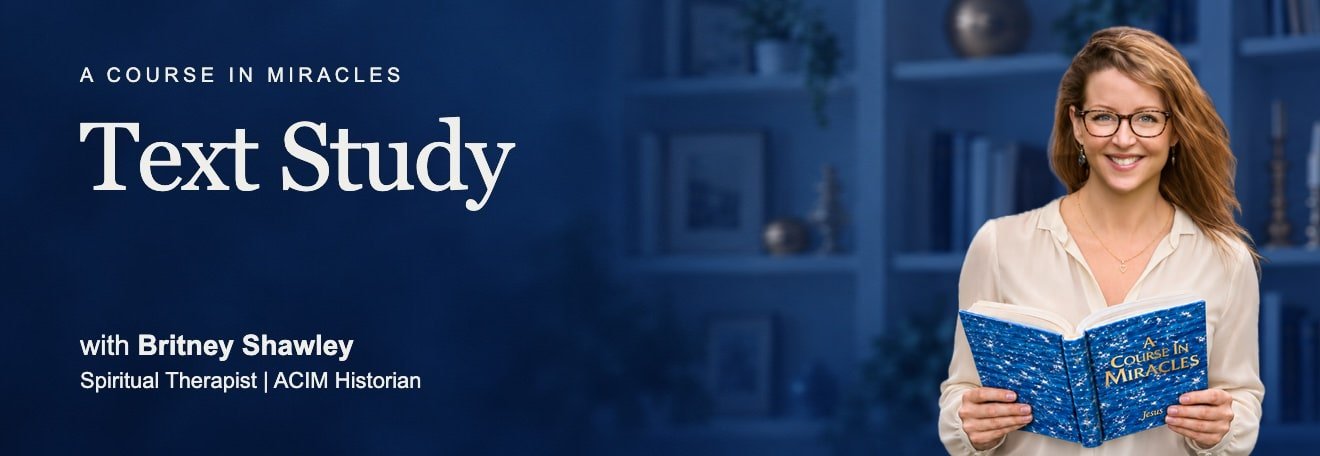
This week in Text Study we read Changeless Reality, which closes Chapter 30. Jesus begins plainly: "Appearances deceive, but can be changed. Reality is changeless." As I read it, I kept thinking this must be how Jesus saw people. He asks us to hold no appearance in place of what our brother really is.
It matters in ordinary days: each time we’d rather see someone as guilty, even a little, we keep the miracle from them and from ourselves.
Our questions went to the root: how a changeless God could allow the tiny mad idea of separation, and why laying our dreams down can feel like loss.
Contents
Chapter 30 Clears the Way for What Never Changes
Before we started reading, I took us back to the beginning of the chapter, because I wanted us to see the whole path Jesus walked us along. It opens with the Rules for Decision, where He sets us up to give our day to God. Each morning we decide for God, decide on the kind of day we want, and leave it to Him. Apart from the workbook lessons, I consider this the most practical part of the book, and if you haven’t immersed yourself in it yet, I really encourage you to.
From there He shows us that following the Holy Spirit or the ego is our own free decision. Then He names the main block to letting God lead our day, which is idols. Putting anyone above us or below us is judgment, and if we’re not seeing each other as equal children of God, we’re not seeing each other at all. Holding an idol amounts to having two gods.
He reminds us that we don’t need to fight illusions. They are like old toys, and we lay them down for God’s laws. Then come the one purpose we all share ("Be merciful unto your brother then, and do not choose an idol thoughtlessly"), the justification for forgiveness, which is always there for every one of us, and last week’s New Interpretation: one interpreter, one meaning, one goal. With the way cleared, we were ready to receive the vision of our changeless reality.
Appearances Deceive, but Reality Is Changeless
The section opens: "Appearances deceive, but can be changed. Reality is changeless. It does not deceive at all." What changes is form, the body and the things of this world. Anything that changes is not of God. The miracle doesn’t fight appearances. It shows they can change, and in changing they are shown to be unreal.
As I read, I kept thinking this must be how Jesus saw people. When the man whose daughter had died came to him, Jesus wasn’t dismayed by appearances. His faith was in what is eternal, which has no opposite and cannot die. The miracle principles tell us we can heal the sick and raise the dead because we made sickness and death ourselves. God makes what is changeless, and we make what changes. Taking responsibility for that is not guilt or blame. It means I can change my mind to align with the changeless reality, in small things as well as big ones.
A dear friend told me about her new sponsor, a cellist who wanted to study at Juilliard. He didn’t get in, and along the way he gave up his house and ended up living in his car. He stayed plugged into God and kept letting Him lead. Through a chain of events I’m honestly not sure of, he was introduced to the very professor he had hoped to study under. She had space in her home, invited him to stay, and is now preparing him to apply again. He has a close, motherly relationship with her that he never had as a child.
The form will be different for each of us. The house, the car and the rejection all changed, but because he stayed locked into the changeless part of himself, it led him to a holy relationship that answered his prayers. He could have closed his heart and decided it wasn’t for him. He didn’t give up on faith. Small stuff, big stuff, all stuff.
Changelessness Is Felt Within, Not Found in the World
One of us shared that while we were talking, she felt changelessness for a moment as our state of being. It was palpable, not a pie-in-the-sky idea, and more real than anything she could see. That is exactly what we prayed for. I’ve opened my eyes after moments like that and said, "This love is so real. It’s so much more real than this." If what I see with my eyes isn’t real, but the love in my heart is, there’s hope for every one of us.
When one of us asked for another example, I pointed to God’s attributes: happiness, kindness, patience, love and honesty. Because they are His, they are ours. That’s why God wills perfect happiness, a happiness that doesn’t change. At first we all yo-yo, and that is simply the human condition. Through every swing Jesus strengthens our choice for reality. I use my emotions as a gauge. When I’m not at peace, I know I have work to do:
"Holy Spirit, help me to see this differently."
The happy dream is the closest we come to Heaven here, a stable experience that includes our purpose, so we know where we’re going and why. None of this can be pointed to in the world. It is revealed within, and that is why faith is the activating agent of everything we do here. The faith will prove it to us.
We Are God’s Child in Eternity, Not a Body in Time
One of us, new to class, named his stuckness: for change to be real, time would have to be real, and the Course says it isn’t. I love that he said it out loud, because I can’t get out of my own stuckness unless I verbalize it. We made time so we could organize our lives. Jesus reverses its hold by teaching us to identify not with a body in time but with God’s child in eternity. He moves us from the horizontal line of past and future to the vertical, where we consult God first: "What would you have me do? Who am I according to you?"
He then shared that part of him says, "That sounds lovely," and another part asks what is being taken away. The first is the memory of home. The second is the ego, which links God’s goodness with sacrifice and loss. Jesus will never take your illusions or even your pain until you don’t want them, and then only peace and love remain.
Another of us offered that the one thing that has never changed is consciousness. Its contents change, so the contents can’t be who we are, and he shared an experience of his own that confirmed this for him. Jesus calls this Christ, the highest we can attain because it’s what we are. That’s why it is okay not to know. The Course isn’t an intellectual pursuit. It points us inward so we can open to the experience.
Someone added that we are a soul, not a body, but the body can express love and miracles. I made a video this week with Corinne Zupko about this. It’s not about denying the body because it changes. It’s about letting the body be used for the changeless purpose we all share. When another asked whether the Course leads to a stillness where breath is barely needed, I said perhaps for a time. We go into stillness to remember the world’s purpose and come back to do our part, not to remember and peace out.
Laying Every Dream Before the Miracle
One of us shared, with real honesty, that change has been the scariest notion of her whole life, and read a passage from The Song of Prayer about laying our dreams down before God. After many years she still doesn’t feel she knows what atonement or forgiveness mean, but she knows she will feel it in her heart soon. Sister, you are safe. That is the simplicity of it. We lay down our dreams when we realize we don’t want them anymore, and there is no loss in that choice.
"What is temptation but a wish to make illusions real?" Temptation is asking the miracle not to touch certain parts of our dream. The fear that something will be taken from us is the ego on guard. When we lay everything at Jesus’s feet, the only things we lose are illusions and pain. Forgiveness is a selective remembering, and what remains is the love we gave and received.
So I give Jesus what causes me pain and what I think causes me happiness. Within the human condition, I may not know the difference. My practice is to question what I hold back: Why do I want to maintain this pleasure or this illusion? When we see what we’re using it for, we can lay it down.
"It will be given you to look upon your brother thus, but not while you would have it otherwise in some respects." The only reason we don’t see the Christ in someone is that we’d prefer to see something else, perhaps the one who is guilty or the cause of our problems. Even small stipulations count: if only you had said it differently. These are the blocks we place between ourselves and our brother. We can’t leave anyone outside a miracle without leaving ourselves out too.
Your homework is to ask:
"Who have I not yet forgiven? Who have I not yet let myself sit down and see their changeless reality?"
This also belongs in our ordinary days. Jesus wants to help with the small tasks, the dishes, the kids and the grocery run, so we aren’t bogged down. The training integrates us into our lives with Christed vision instead of separate perception.
We Were Never Separate, and the Course Trains Us to Experience It
One of us asked how a changeless, all-knowing God could ever allow the mad idea, and whether change itself is the point. I’ve asked these questions too, and we need to think them through. Everything in time changes, but God is the container that holds it all, and the container doesn’t change. I believe He created us as an extension of love, and that we, as His creative children, got curious about what separation would be like. Jesus gives this a name in the book: the tiny mad idea.
We were never actually separate. When we believe we’re a body and feel fear, we experience separation, but the instant we wanted that experience, God gave us the Holy Spirit as the link back. Nothing in the book confirms separation. It confirms our changelessness.
The chapter ends: "This will you look upon when you decide there is not one appearance that you would hold in place of what your brother really is." Will his body, his history and what he did or didn’t do appear to me as real, or the Christ in him? I will only see the light in him if I want to. You don’t have to know how. You only have to be willing, and you will be shown. "Why should you fear to see the Christ in him? You but behold yourself in what you see."
One of us is practicing the lesson "I call upon God’s name and my own." The name God gives His Son is Christ. This happens quietly in our minds and hearts, not by proclaiming it, and it shows up as love, forgiveness and kindness.
When one of us asked how the Course differs from religions that require willingness first, I said every skill has a training period. The difference is that no person or organization is at the helm. Go to the Holy Spirit. The Course says a universal theology is impossible, but a universal experience is necessary. It feels alive through us, as he put it, and it teaches love without opposite. Another reminded us that Lesson 189 points beyond the book itself to God. It is a way, not the only way.
Final Invitation
This week, I invite you to notice where you are still holding an appearance in place of what your brother really is. It may be someone you love and keep guilty just a little bit, or someone you’ve quietly decided is the problem. You don’t have to judge yourself for it. Just notice it.
When you catch it, ask yourself: Who have I not yet let myself see in their changeless reality? What am I holding back from the miracle, and what do I think I would lose? Then give it to the Holy Spirit:
"Holy Spirit, help me to see this differently."
One small step for today: before you begin one ordinary task, ask Jesus to do it with you. Let that be where you practice seeing the Christ, in the kitchen, at work or on the phone. When you see it in your brother, you will know it in yourself, because his appearance is your own. God is changeless, and so are you.
The Simplicity of Salvation
Tue, Nov 17 | 1:30–3 pm ET
We’ll read the next section together and explore its meaning through reflection and our questions. Come early at 1 pm ET for Spiritual Therapy before our Text Study begins at 1:30 pm ET.