

The Simplicity of Salvation
My friends, we opened the last chapter of the Text with “The Simplicity of Salvation,” where Jesus tells us that what was never true is not true now and never will be. I loved how he honors our enormous skill as learners, then reminds us that we used it to learn God’s Son is guilty.
This matters in every ordinary moment, because the lesson we choose, guilt or guiltlessness, becomes the world we see.
Our questions brought this home to our relationships: how to hear the call for love when a brother attacks, and how to ask Jesus which miracles are ours to perform.
Contents
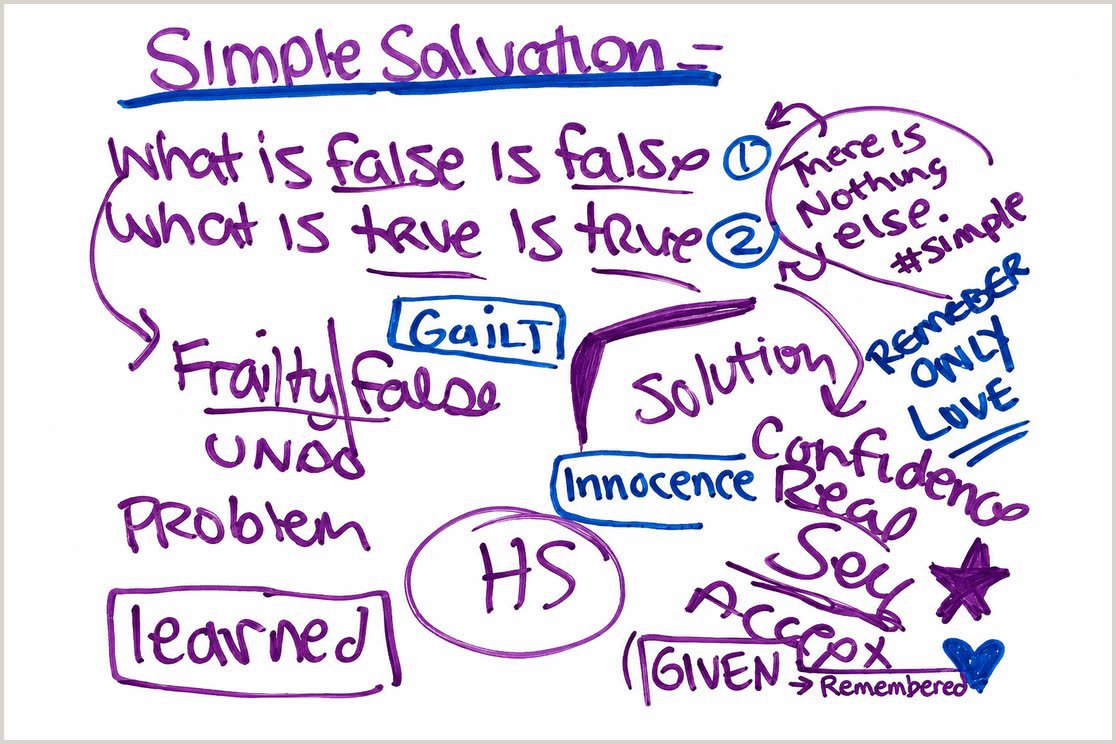
Salvation Is as Simple as False and True
Jesus begins the final chapter with a line I could hardly read without smiling: "How simple is salvation!" What is false cannot be true, what is true cannot be false, and there is no in-between. When one of us said it is so simple that we must make it complicated, I agreed. We do.
This is the whole Course. It echoes the very beginning of the Text, that nothing real can be threatened and nothing unreal exists, and herein lies the peace of God. It is also what Lesson 47, "God is the strength in which I trust," asks when it has us recognize our frailty and gain confidence in our real self. Our frailty is false and the real self is true, so all we are doing is undoing and accepting.
I don’t define truth, and neither does any other Course teacher. Truth is defined by God alone, and He would never leave us in the false without a way home. So the Holy Spirit mediates between the false and the true, which is why Lesson 49 says, "God’s Voice speaks to me all through the day." Jesus calls the false anger in one place and judgment in another, yet it is always one problem with one solution.
When one of us wrote in the chat, "Oh my God, we did this," it went straight to my heart, because we did. Every thought I’ve had about my worth and my not-good-enoughness was learned. Since it was learned, we are only unlearning it so we can remember what is given, and we are innocent in the learning, because we didn’t know what we were doing.
We Exist, and We Wake Up Together
One student pictured a small child building a model of the world: I am this body, other minds are out there, and this person thinks I’m ugly. Then the child goes looking for proof, even though the meaning of a word like "ugly" lives only in our own minds.
I learned that word from my mom, who is beautiful in every sense, looking at pictures of herself and saying, "Oh, that’s so ugly." Because I look like her, I decided I must be ugly too, and so a stranger saying it would have hurt, because I believed it. After my inner work, I see that she didn’t know any better and that we are both beautiful. Now I would simply wish that stranger a good day.
The same student added that whatever anyone says, we exist as part of what God created. There is a big narrative in our community that you don’t exist. My ego doesn’t exist and my body is not what I am, "but I am an eternal being of life."
That answered a question that comes up often: is salvation a happy life here, or waking up to our real home? It’s both. God’s will for us is perfect happiness, so we experience that happiness here, and our brothers and sisters remember God through our kindness and forgiveness. We don’t fully wake until everyone wakes with us. We’re not trying to escape; we bring Heaven to earth first.
This is why I call "I am as God created me" the goal of the Course. One of us shared Lesson 224, which ends, "This is reality, and only this. This is illusion’s end. It is the truth." The only difference between Jesus and us is that he accepted this about himself and nothing else.
We Are Powerful Learners Who Learned the Wrong Lesson
Jesus reminds us that we learned to be a body and a personality, along with the laws of this world and the meaning of every word. "There is no greater power in the world." That proves we are very good learners, and all salvation needs is that learning skill given to the Holy Spirit with our willingness.
He puts it plainly: "You who have taught yourselves the Son of God is guilty, say not that you cannot learn the simple things salvation teaches you!" I hear him saying, in effect, congratulations, your learning is immense, but you learned the wrong thing, so come home. And these simple lessons are taught to us in every moment of every day, because our brothers are everywhere.
There is one caveat: we have to listen. Thoughts like "I don’t hear the Holy Spirit" or "I can’t tell when He’s guiding" are part of what we learned. His Voice never stops speaking; we are simply preoccupied with the other voice. So we can remember that He was placed in us, be open and ask:
"Holy Spirit, speak to me."
Showing up to class tells me you already know the difference between what loving feels like and what fearful or withdrawn feels like. So the prayer becomes:
"Holy Spirit, Jesus, help me to accept the truth that I know is here for me to accept."
As we focus on accepting what is real, whatever interferes comes up naturally to be laid down. We have one focus, which is salvation and our holy self.
Guilt and Guiltlessness Make Two Different Worlds
Then Jesus tells us the lessons to be learned are only two, and each has its outcome in a different world. Whatever we decide is true inwardly, we project outward. The lesson that God’s Son is guilty makes the world we see, a world of terror and despair. The lesson that God’s Son is guiltless makes a world that "sparkles with gentle friendliness" (yes, my word is in there).
Guiltlessness is the first lesson for us. Like a little child who throws a stick and hurts someone, we don’t know what we’re doing, even in adult bodies. The lesson can seem hard because the call for love comes hidden in a rough package of hate, judgment or someone calling you ugly. When meanness comes out of that package, you better believe it’s a call for love. So if my mind says someone is guilty or to blame, myself included, I know I’ve missed the lesson at hand and return to it: "I don’t want anybody to be guilty."
One of us shared that she had decided to leave a partner of eight years. Once she decided, they made amends and wept together in love, and she wondered why that would happen if she was leaving. I suggested that the decision cleared the way for each to see the other’s innocence. That miracle isn’t saying "get back together"; it’s saying, "Thank you, God, that truth is true." Her question is not whether they are meant to stay together but what God is showing her, and a decision for her happiness includes him.
Miracles Go Where the Willingness Is
One of us asked how to know where to stop offering miracles when someone keeps harassing you and you feel drained. From memory, I recalled Jesus saying something to the effect of asking him which miracles to perform. We don’t know what another person needs, so we ask, and he guides us.
Miracles are natural; love extends as a receiving and a giving. But if someone is unwilling to give or receive love, no amount of trying will make it work, because of free will. I go where the willingness is, and if a brother wants to stay right and keep defending, that’s no space for a miracle worker.
Another of us showed what willingness looks like. Instead of asking a partner to see him, he looked at where he hadn’t been responsible himself, released that grievance to the Holy Spirit and could see her as sinless. With love, he also said he would only be in a relationship where both take responsibility. That is the move from special to holy: equal giving and receiving, both willing to do our inner work and come back stronger.
When one of us wrote about seeing ourselves and others as guiltless and blameless, I said amen. When we stop blaming others or our parents, responsibility appears, and responsibility is our power. Elsewhere Jesus speaks of "I have done this unto myself." That isn’t blame. It means I can give my guilt to Jesus and become an open channel for my confident self of love.
The ego hates this, so it protests. When one of us asked whether this is ego death, I said yes, and there is no loss in losing the ego.
The Call Behind Every Attack
Jesus writes of "the call that echoes past each seeming call to death, that sings behind each murderous attack and pleads that love restore the dying world." One student had just shown us this. She has felt like an alien her whole life, wondering why people are so mean, and was preparing for an autism assessment while working the Course. Days before, she had been in a very dark place where the mind turned toward death, and an aunt prayed over her, "God, I do not know what to do. You know what to do." In days of prayer, she saw that only God tells her who she is.
She cancelled the appointment. I said she had demonstrated salvation: she is love because God made her, including her perfect autistic brain. My own brother, self-diagnosed, played his part perfectly too. Her cry about a mean world was love pleading for everyone, because when we heal, we don’t heal alone.
So when the fearful voice gets loud, I acknowledge it, "I hear you, this feels awful," and listen beneath it: "Speak to me, Holy Spirit." Answering in the language of the call is love for love. The chapter’s final paragraph asks us to be still and forget all we learned, so that each brother is born again to us, "because an ancient learning passed away, and left a place for truth to be reborn." That ancient learning is the ego.
One student asked what to do when self-hatred becomes an ego storm. For me, the next step is always prayer:
"I can’t get myself out and I don’t know how to get out, but Jesus, you do. Help me."
If the feeling stays, that’s okay. Keep asking to see the truth, and it will break through.
Final Invitation
This week, I invite you to notice the moment your mind makes someone guilty, whether it’s a partner, a stranger or yourself. Let that be your signal, without judging yourself, that the first lesson is at hand. Then gently ask, "What is the call for love in this?" and "Is this a giving and receiving, or am I being asked to step back?"
When the feelings stay loud, take responsibility rather than blame, and hand the guilt over. Pray as simply as you need to: "Jesus, help me. I want to see the truth." Then do one small thing today, like a moment of stillness, a kind word or a quiet thank you, and let love answer love.
We learned guilt with all our strength, and that same strength is given back to us now. God is love and nothing else, and you are exactly as He created you.
Walking with Christ
Tue, Nov 24 | 1:30–3 pm ET
We’ll read the next section together and explore its meaning through reflection and our questions. Come early at 1 pm ET for Spiritual Therapy before our Text Study begins at 1:30 pm ET.