

The Justification for Forgiveness | Part Two
Watch the recordingIn this week’s Text Study, we finished The Justification for Forgiveness in Chapter 30. Last week, Part One covered the first four paragraphs of this section. This week we picked up at the fifth paragraph, "Forgiveness recognized as merited will heal," and read through to the end.
Jesus keeps asking us one thing across these paragraphs: will we let forgiveness be total? Once we hold even one person, one act or one appearance outside forgiveness, our forgiveness becomes partial. Then our own release from guilt becomes partial too.
This is very practical, my friends. Our questions took us into the anger that keeps coming back, the habits we battle every day, the people who still harm others, and the old pain we carry from childhood. In each one, we kept coming back to the same invitation: look past the surface, get to the root, and let Jesus show us what is real.
Where Part One Left Us
Before we read, I took us back through last week’s teaching. It doesn’t hurt to repeat it many times. Jesus begins this section by reminding us that attack and anger are never justified, whether they come from the world toward us or from us toward the world.
He is also clear that he never asks us to pardon where attack would be deserved. This isn’t patronizing forgiveness, the kind that says, "I forgive you because you’re a sinner and a terrible person." That isn’t forgiveness at all. Forgiveness won’t happen until we see it as justified. So the real work is changing what we value, and choosing the foundation we want to grow on.
On the board we looked at two worlds again. The first is the world of fear and illusion, formed from error and distress. It isn’t of God and it isn’t of you. It is only the blocks to the second world, the world of love and reality that Jesus came to show us is already here. Pardon is always justified because it is the foundation through which God’s changeless love can show up in this world. Even when we have angry, fearful thoughts, or make mistakes we think are sins, the love of God is still in us.
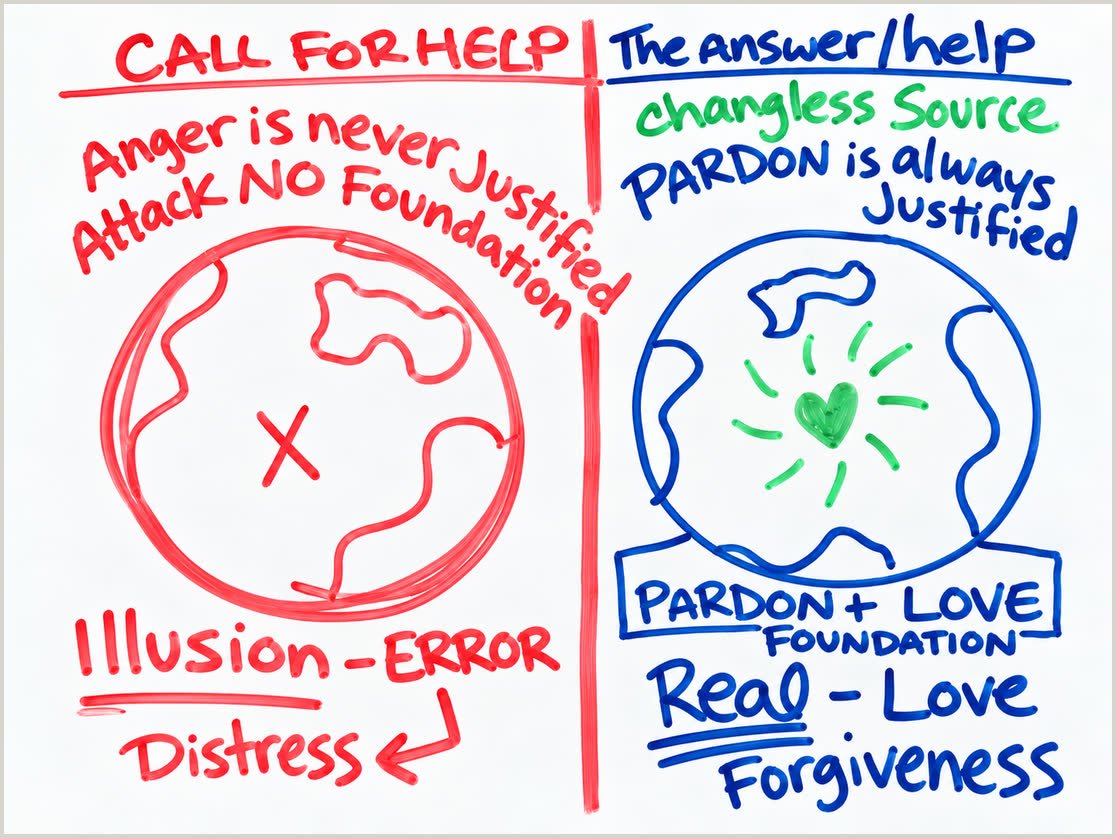
I compared it to a plant. If you pull off the petals, the plant grows back, because the root is still in the ground. Getting rid of fear or anger on the surface is like plucking petals. Forgiveness digs down to the root. Then nothing can grow back.
And remember: you didn’t sin, you made a mistake. That means others aren’t sinning either. They are making very innocent mistakes on planet Earth. Beyond those mistakes, forgiveness shows you that you are an innocent child of God, loved, lovable and loving. It gives you back your happiness, your peace, your purpose, and the memory of who you are.
Forgiveness Has to Include Everyone
Our first reading began with "Forgiveness recognized as merited will heal." In this passage Jesus explains that if any appearance couldn’t be overlooked, there would have to be a sin beyond forgiveness. That would be an error bigger than a mistake, unchangeable, with the power to undo creation itself. He says that believing some forms of sickness or joylessness can’t be healed shows we still want to keep some idols.
All through this section, Jesus ties forgiving others to being forgiven ourselves. If we want to know we are forgiven, we have to see others as forgiven, because as we give, we receive. That is God’s law: give first, and then you will know you have it.
This goes back to the first miracle principle in Chapter 1: there is no order of difficulty in miracles. No miracle is harder or bigger than another. That is why Jesus could heal leprosy, raise the dead, and also settle the disciples’ anger with one another. To him, every problem from anger to death had the same answer.
So if we forgive many people but keep a few in reserve, we are choosing an idol over God. We can’t leave anyone outside forgiveness, including those history calls the darkest. When someone causes great harm, it may well be because they were deeply hurt themselves. Do they deserve condemnation forever, or help and love they may never have known? All the horror on this planet is people calling for love. As miracle workers, we are learning to give miracles to everyone and everything without exception. When we do, we come to know that we are entirely forgiven ourselves. That is salvation.
Have I Ever Done Anything Like That?
When I see someone as mean or wrong, I try not to condemn them. Instead I pause and ask:
"Have I ever done anything like that before?"
For years it bothered me that my dad would sometimes lash out in anger when a topic came up that he disagreed with. When I tried to forgive him, I had to ask myself that question honestly. The question isn’t whether I did it as badly as he did. It’s whether I’ve ever made the same mistake.
When I looked honestly, I saw that I had done it many times with Tom. He would say something about parenting, I would take it personally, and I would snap back. What’s the difference? There isn’t one. It’s the same problem and the same mistake. When I forgive my dad, I am forgiving myself for exactly the same error. The scale doesn’t matter.
One friend added that there is great freedom in seeing that everything on the level of form happens for our growth. It stopped her from condemning herself and from condemning her brother, because there is always something for her to learn. Life isn’t happening to us, it’s happening for us. The same is true of our triggers. We don’t get triggered because we’re bad Course students. We get triggered because we’re ready for that part of us to be brought to the light for healing.
The Leaf and the Root
Laura asked for an example of a root cause versus a leaf cause, so I drew a weed (one you’d want to pull out) with a heart-shaped root underground. The leaves are what we notice: anger, fear, judgment, anxiety, addiction. They are the last layer. But leaves don’t grow for no reason. Underneath is a condition, a belief, a use.
When we pray, "Jesus, take away my anger," we are asking him to take a leaf, and the pattern comes back. He asks us instead to let him remove the belief underneath. The question that matters is:
"What is it for?"
Am I using this anger to keep believing I’m a weak little body with nothing to give? To prove I’m not good enough? Do I think this fear protects me? When we ask what it’s for, Jesus and the Holy Spirit will show us.
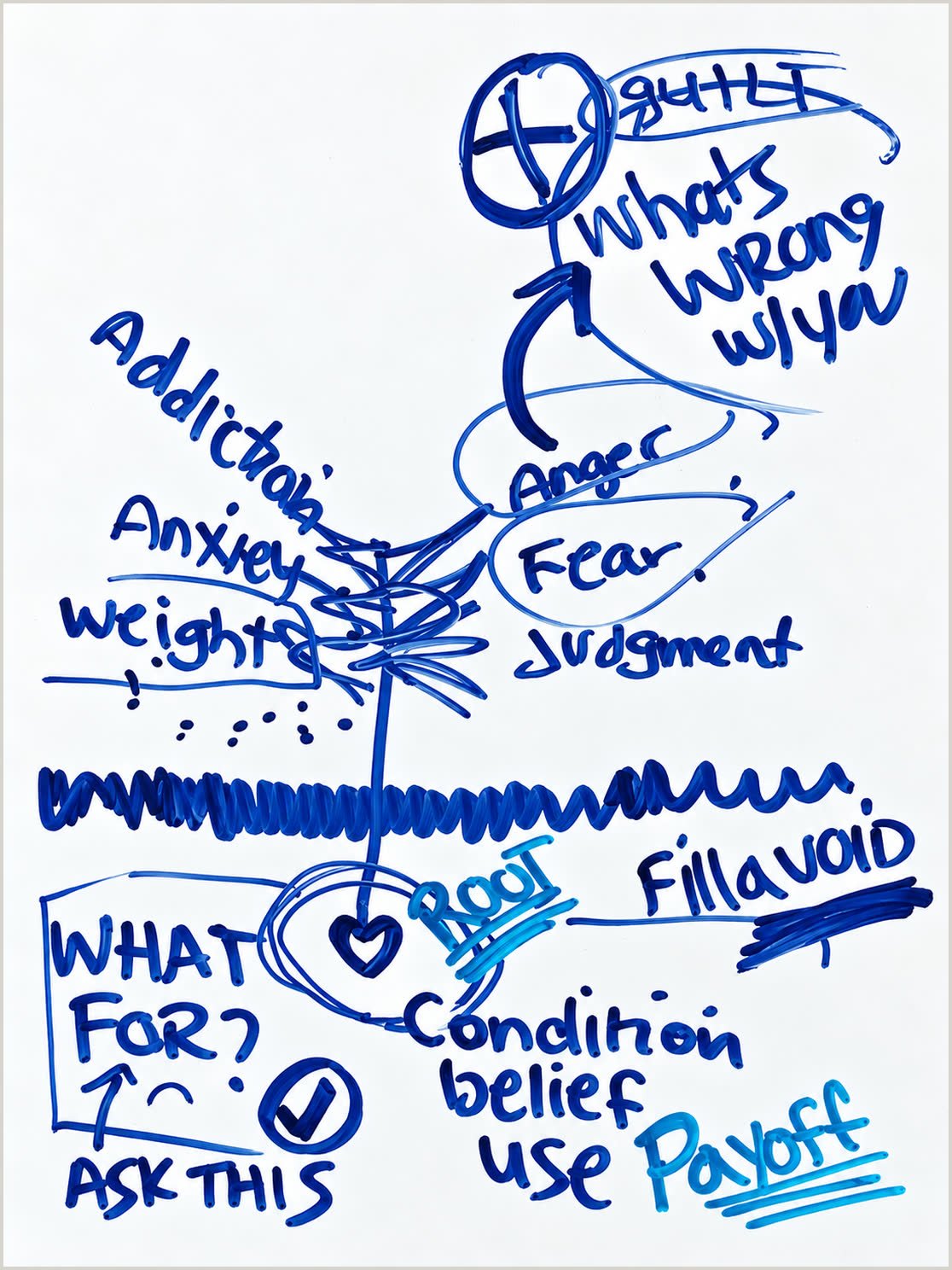
My own example was weight. I once weighed over 210 pounds at 5’3". For years I worked on the leaves: eating better, going to the gym, trying to think better thoughts. Then I would binge at night, feel terrible, and battle myself all over again. Nothing changed until I asked, "Why am I overeating?" Jesus showed me I was trying to fill a void, an emptiness inside.
So I stopped trying to control the food and the gym, and I focused on filling that emptiness with love. I worked on loving thoughts and loving actions, and on loving my body as it was instead of judging it. In time I was led back to the gym with the right training for me, and to the right way of eating for me. The weight fell away as an effect, and it has never come back.
All along, my ego kept asking, "What’s wrong with you? You teach this stuff!" That only added guilt. It’s the wrong question. "What is it for?" is the right one.
Glenn shared that when he quit fighting himself, he didn’t surrender, he was surrendered, and he was no longer blocked from the sunlight of the Spirit. That’s exactly it. And forgiveness doesn’t mean ignoring the body. It starts with taking our hands off the wheel. Then it grows into a new, loving relationship with our body, our emotions, and the people we are forgiving.
The Miracle Heals All or Nothing
Our second reading began with "It must be true the miracle can heal all forms of sickness, or it cannot heal." Every leaf we named is a form of sickness, because it comes from the distressed mind. It is literally all or nothing. Reality can’t correct some illusions and not others. There is no order of difficulty in miracles, and no order of difference in illusions. Thank God.
That’s why Jesus says, "You must forgive God’s Son entirely." God’s Son is you, me, all of us, Jesus included. This led to our homework question:
"Who or what have I not yet forgiven entirely?"
Write the list. Include anyone who makes you feel less than wholly joyous, anyone who irritates you, anyone you feel betrayed by. Don’t be surprised if you’re on it. As one friend reminded us, we’re usually at the top. Then take one person at a time and ask what about them upsets you. Let yourself be shown what in you it reflects. If the list is long, don’t let your ego judge you for it. It’s innocent and very neutral.
When an Offense Keeps Happening
One of us asked how to apply this when offenses keep happening. First: if you are actually in harm or danger, leave. Jesus would never ask us to stay where we’ll be harmed.
If it’s an offense rather than harm, like a loud neighbor upstairs, it continues because it hasn’t been forgiven yet. That’s often because we haven’t forgiven ourselves for something similar. The ego speaks loud and first, but there’s another way to see. I added a second question to the board:
"What’s the payoff?"
In my early twenties, I felt so unlovable that I looked for love in men’s attention and gave myself away to get it. The payoff was feeling loved. I had to let go of the idea that this dynamic could give me anything. Only then could I see myself clearly and love myself.
The Cross and the Logic of Love
Jamie asked why Jesus surrendered to the cross. I believe he knew it was his part in salvation, and he knew he wouldn’t die. He took on the hate and condemnation of his time and didn’t retaliate. What he gave was forgiveness: "Father, forgive them, for they know not what they do." They couldn’t see him through the darkness, and he loved them anyway, because he knew what was real. His was the most maximal demonstration there could be. If he could forgive in those circumstances, we can forgive in far less intense ones. And no one has to go to the cross again. Suffering is unnecessary.
James shared how he came close to taking verbal revenge on some people, then caught himself and saw that this pattern had hurt him more than it hurt them. That pause was the miracle. He included himself in the healing. As I said to him, it isn’t really them we forgive, it’s ourselves, and that naturally extends to them so that everyone is free.
He also named something many of us feel: forgiving people won’t stop them from harming others. Darkness can’t drive out darkness. If I hate someone who is harming others, I feed the same illusion and keep us both stuck. If I want the meanness to stop, I have to stop being mean, even toward a mean person. Our part is to remember the light hidden in them, forgive the mistakes on top, and stay open to how we might serve.
Healing Doesn’t Have to Take Time
Glenn shared that the self-condemnation he carried wasn’t forgiven by any effort of his. When he was ready, it was simply removed. That reminded me of Jerry Jampolsky’s Love Is Letting Go of Fear. When fear is removed, love remains. You don’t even need to be forgiven; you already are.
One of our community shared, with great honesty, about suffering that has felt unbearable. She was asking what she believes that isn’t true. Her honesty wasn’t a burden. It was willingness, and we prayed together. Part of that prayer was:
"We don’t know the solution. We don’t know how to forgive. We don’t know how to solve this or fix this, but God, we know You do."
Annette, who is new to the Course, then felt led to share the woman healed by her faith in Mark 5. It was a holy way to end our class. It showed that we don’t need more books or more time to be ready. We can receive now.
God’s Son Is Perfect
The section closes with a line I called the heart of forgiveness: "I thank You, Father, for Your perfect Son, and in his glory will I see my own." We can say it about our mom, our dad, our friends, school, religion, work, the world, and even our own self-sabotage, seeing that each played its part in our curriculum. That is how self-hatred ends.
"Look on your brother with this hope in you," Jesus says. No error can change the truth in him. There isn’t one human being without the light, however hidden it is. Our job is to let that light grow in our awareness until it’s the only thing real about them to us. That leads to gratitude, and to seeing everyone as our savior.
Final Invitation
This week, I invite you to notice where you’re still keeping someone outside forgiveness. It may be a parent, a neighbor, a public figure, or the person in your own mirror. Notice it without judging yourself. It’s simply the next place you’re ready to heal.
When anger, fear, or an old habit comes up, please don’t stop at the leaf. Pause and ask, "What is it for?" Then ask, "What’s the payoff?" And when you judge someone else, ask honestly, "Have I ever done anything like that?" Sit down with your list, "Who or what have I not yet forgiven entirely?", and take one name at a time. If you’re in real harm, step away. Forgiveness never asks you to stay in danger.
Then give what you find to Jesus and the Holy Spirit. You don’t have to fix it or understand it. Hand it over, and say for each person on your list, "I thank You, Father, for Your perfect Son, and in his glory will I see my own." Let the light in them become what is real to you, and remember that love is what you are.
Live on Zoom | Spiritual Therapy
Tue, Nov 3 | 1–1:30 pm ET
Bring a question about something you’re facing and explore it live with Britney. Stay for Text Study at 1:30 pm ET as we continue Chapter 30: The New Interpretation.